Friday, 24 February 2017

Poor Bill Oddie!

I watched the Real Marigold Hotel episode 2 with low expectations, which it rose to meet.  Poor Bill Oddie a lifelong bird watcher and wildlife expert was driven off into the Western Ghats to watch birds. I hope he saw more than were shown on the film: a kingfisher and a coulcoul.
Watching birds is one of the great pleasures of a lazy hour in the sun. From the jetty of the Ayurveda centre shown on the film I have seen bee eaters, several types of kingfisher, coulcouls, whiskered terns, herons, egrets, three sorts of cormorant, ducks and the inevitable crows, and a dolphin, which I am assured is not a bird..
Half an hour at breakfast in he mountains yielded bulbuls, babblers, magpie robins, flower-peckers, parakeets, shrike and many others I could't identify. A short walk bagged me a hornbill. Check out the endemic species here.
https://www.flickr.com/groups/1204640@N25/pool/

All of this is, of course, in detail in my book.
https://www.amazon.co.uk/Looking-Muziris-Through-History-South-ebook/dp/B00KVIL8DO

for which this is a shameless puff. On my last visit things had changed a lot. There were far fewer birds, probably fallen victim to the great economic miracle of India with its development and pollution. I am sure poor Bill Oddie could have managed more than a kingfisher and a coulcoul, though.

Tuesday, 21 February 2017

Check out the Real Marigold Hotel

I am a sucker for any television programme about India. The current BBC offering of the second series of the Real Marigold Hotel sends "celebrities" to see if they would enjoy retirement in India. This series is set in Fort Kochi and the oldies are put up in a five-star hotel close to the Parade Ground. Who wouldn't like retirement in a five-start hotel! The real price would be a bit beyond my budget.

However, it is all good fun and it is good to see the familiar places through the eyes of a heavily-edited television lens.

Check it out:
http://www.bbc.co.uk/programmes/b08fpbkd

Monday, 23 May 2016

The Pandayan Empire


The road East across the plain leads inevitably to the large city of Madurai, centre of trade of the great Pandyan Empire. This was the peak of the great Sangam age. The Sangam Academies of scholars were centred in Madurai and flourished between about 300 BCE and 400 CE. They laid the foundation, through great works of literature for a defined linguistic area, the Tamilkam, roughly corresponding to the whole of the South. The third Sangam, or congregation of scholars and poets was held here in around 1800 BC. The first and second Sangam ages are generally accepted as mythical, one legend telling that they were held in cities since inundated by the sea.

The Pandyan Empire
When the first Greeks came here the Pandyan Empire spread over most of the extreme tip of the peninsular. Present-day Sri Lanka was part of this kingdom, but the lands in between were still primitive and controlled by small chiefdoms. By the time of the Roman Empire the Cholas to the East and the Chera to the West had pushed the Pandaya further South. The area had always been a seething mess of small chiefdoms, sometimes allied to the main Pandyan rulers, sometimes fighting against them.  
The Chola, to the North and West, built a maritime trade. By the first century CE they were actively trading with South East Asia and Indonesia, and had a developed Navy. The great wealth which came from overseas trade helped to build a well-organised and cultured society. They declined from the end of the Sangam period until about 850 CE. One of the rock edicts of Ashoka mentions the three “crowned” dynasties of the South, the Pandyas, Cholas and Cheras.
The wealth which enabled the great Pandya city of Madurai to grow and thrive came from two directions, both East and West. Madurai, positioned in the centre of the peninsular and with access to the sea routes to the extreme South in Tuticorin and Sri Lanka and to the West via the gaps in the mountains. It may hold the record for the longest continually-inhabited city in the world.
Sangam poetry tells of the richness and sophistication of the time and is often the only historical source remaining. The Greeks and Romans knew the city well and traded here, caches of coins and records unearthed far away telling of the spices which were taken out and the wine and silks which went in the other direction. There is even evidence of Greek soldiers serving in the army of the Pandyan kings. There are good classical references to the kingdom and its trade in both Greek and Roman sources.

Nothing can be seen now of Madurai’s ancient roots. The temples came much later, but there is much in Madurai which is timeless. The market traders sit at the roadside in front of their produce. Right next to the temple the tailors trade from booths where they are packed in so tight that it is difficult to see how they can manage to move their sewing machines and the shoppers push and shove to negotiate the narrow walkways.  Just outside the city the rock-cut temple bears hundreds of years of soot from lanterns and butter lamps and the elephant gives its age-old blessing to anyone with donation. Away from the city on the surrounding hills where wild-life still proliferates, the four huge gopura dominate the low sprawl around them, just as they would have done in previous centuries, and Madurai is still a city of trade

In the Sangam age the South was divided into five areas whose boundaries are uncertain, but which seemed to be based on topographical features. Kuttenad is still recognisable today in the low, rice-growing area, Venad the present day Trivandrum region, or “Land of the Chieftans”. In the early years of this period the Ay dynasty in the South and the Ezhimalas in the North separated the Cheras who came in between.

Friday, 20 May 2016

The world outside India

The far East was experiencing its own growth of philosophy and thinking. Buddhist monks had probably reached China by this time and some of the most significant philosophers made their appearance.  Confucius (551 to 479 BCE) introduced a philosophy that combined ethics with religious traditions, a philosophy that would dominate Chinese political structure until the 20th century. At about the same time, we also see Laotze introducing a more sophisticated version of traditional nature worship called Taoism, in one of the greatest books ever written, the Tao te Ching. The Tao philosophy was to influence later Buddhism.
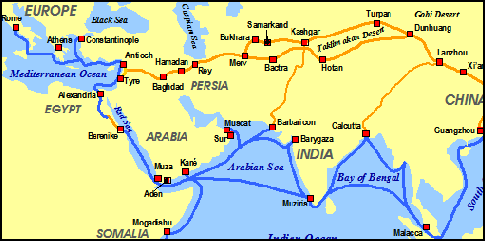
From 403 to 221 BCE, China was split into a number of warring states.  In 221 BCE, the Ch'in dynasty established its rule.  The Ch’in were great organisers and administrators. They began the task of building the Great Wall to keep out the invading Huns. The Ch’in were overtaken by the Han, who defeated the Hun and expanded Westwards, building new trade routes and establishing the longest and most persistent of them all, the Silk Road. This route joined sea routes as it wound its way across continents to Rome and further Westwards. Although there is little evidence of direct trade with the Chinese at this time, finds of Chinese Porcelain suggest that Chinese goods were reaching the South of India. They were certainly reaching Rome; the Emperor Augustus forbade the wearing of silk as a drain on Rome’s resources.
http://factsanddetails.com/china/cat2/sub90/item50.html

The connection with the East and West allowed for the free exchange of ideas and trade.  The links between South India and the Empires of the Middle East were already strong. From 2000 BCE Arab traders, who were very cagey about the origins of their goods, imported  spices, precious stones, cinnamon, ivory, pepper, ebony and sandalwood and sold them in Egypt and around the
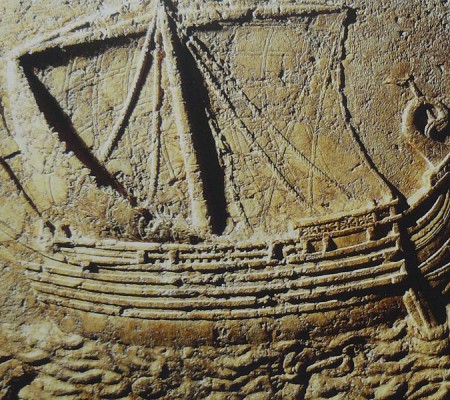
A sturdy-looking Phonecian ship
http://exploration.marinersmuseum.org/watercraft/phoenician-ships/
Mediterranean.  The great Assyrian rulers, Assurbanipal and Tiglath Pileser 111 recorded cotton and other common articles of South Indian origin, and there were records of imports of elephants, tiger and leopard skins, spices, gingelly oil and other commodities until the fall of Assyria in 600 BCE.
King Solomon, who reigned around 1950 BCE reputedly sent his fleet to India, and the fabled port of Ophir was said to be in the South of the continent. He did receive ivory and peacock feathers from somewhere, but he is also said to have had ships filled with gold, something not found in the South, and it is unlikely that gold from another country was being traded. However, it is likely that his fleet reached India and traded there, whether in the South or the North. The seas between India and the Middle East were known by most of the empires of the ancient world, and these empires must have been familiar to the populations of South India. Trade routes hugged the coasts and eventually connected with the great overland routes carrying tea and silk from China.  Connections between the South Eastern coast and the West of the continent were hampered by the ridge of the Western Ghats, although the Palghat Gap allowed for some to-ing and fro-ing and was one of the routes goods to Madurai, the great trading town in what is now Tamil Nadu, would have taken.
Roman trade: Relief from Trajan's column

In about 302 BCE Greek ambassadors, under their leader, Megisthenes visited the Ganges plain, and there is a tradition that he reached as far South as Madurai. The city, which was the centre of the Pandyan dynasty, sent representatives to Greece and Rome and trade flourished there. He wrote a four-volume book, Indika, which has been lost in its entirety. Fragments remain and it was quoted and interpreted by later scholars such as Pliny, Strabo and Aelian. They made little of the outrageous claims Megisthenes made about the people and fauna of India, and later geographers and historians discredited his accounts. Many of his strange descriptions might be a result of language and cultural problems, although explaining these creatures could prove difficult:

"Equally absurd is the account given of the Enotokoitai, of the wild men, and of other monsters. The wild men could not be brought to Sandrakottos, for they refused to, take food and died. Their heels are in front, and the instep and toes are turned backwards. Some were brought to the court who had no mouths and were tame. They dwell near the sources of the Ganges, and subsist on the savour of roasted flesh and the perfumes of fruits and flowers, having instead of mouths orifices through which they breathe. They are distressed with things of evil smell, and hence it is with difficulty they keep their hold on life, especially in a camp. Referring to the other monstrosities, the philosophers told him of the Okupedes, a people who in running could leave the horse behind; of the Enotokoitai, who had ears reaching down to their feet, so that they could sleep in them, and were so strong that they could pull up trees and break a bowstring. Of others the Monommatoi, who have the ears of a dog, their one eye set in the middle of their forehead, the hair standing erect, and their breasts shaggy; of the Amukteres also, a people without nostrils, who devour everything, eat raw meat, and are short-lived, and die before old age supervenes. The upper part of the mouth protrudes far over the lower lip. With regard to the Hyperboreans, who live a thousand years, they give the same account"
Strabo, from Megasthenes: Indika, Trans. J. W. McCrindle

Megisthenes also described the caste system of the Indians, describing seven castes and marvelling at the fact that there were no slaves. As these accounts percolated Westwards they established India as a place of mystery and strangeness. Within India itself, the Aryan culture was spreading South with the Mauryan kingdom, which had an aggressive policy of taking its superior way of life to the less- advantaged people elsewhere. In Madurai the Pandyan dynasty was jostling with the Chola and Chera for primacy in the great age of the Tamil Sangam.


Monday, 2 May 2016

Influences from he West.

The life of the Buddha might have been consigned to the dustbin of history as little was heard of  the localised sect in the kingdom of Maghada for two hundred years or so, but the West was spreading its influence Eastwards and routes were opening up by commerce and conquest..
The extent of the Mauryan Empire under Ashoka
The greatest upheaval in the North was the conquest of a large area by Alexander the Great, who had become King of Macedonia, leader of the Greeks, overlord of Asia Minor and Pharaoh of Egypt and 'great king' of Persia at the age of 25. In 500 BCE the Persian King, Darius, had invaded the Indus Valley but the Greeks conquered Persia and he got no further. In 326 Alexander’s armies took a large area of the North, defeating the local ruler, Porus.  By the time the European and Paurava armies faced each other across the banks of the river Jhelum in the Punjab, Alexander’s troops were weary after a long campaign and some hard-won victories in present day Afghanistan and Pakistan.  The 34,000 Macedonian infantry and 7000 Greek cavalry were aided by the Indian king Ambhi, who was Porus’s rival. Ambhi was the ruler of the neighbouring kingdom of Taxila and had offered to help Alexander on the condition that he would be given Porus’s kingdom.
The large numbers of Indian infantry and the war elephants proved a great trial to the Macedonians, but after a ferocious battle Alexander finally prevailed. His conquests spread to what is today the Punjab, spreading to Jammu and the Himalayas. He made alliances with local rulers, and when he returned to Persia, discouraged and with an exhausted and rebellious force, he left several generals to rule the provinces from his centre, Taxila, now in modern Pakistan. Although his rule was very brief the influence of Greek art and culture was long-lasting. As Macedonia broke up following Alexandra’s death, the Selucid Emperor, Nicator, ruled in his place and held the territories in India. It is possible that the reputation of the growing power of the kingdoms of the East were a further disincentive to Alexander to expand his conquests to the Ganges valleys.
While Alexander was taking territory in the West, Chandragupta  Maurya was taking the Nanda lands
round the Ganges Delta. His ambitions led him further West and he met Nicator in battle and defeated him. The resulting treaty, sealed by a marriage, gave the growing Mauryan Empire most of Alexander’s gains. Chandragupta’s statecraft and administrative talents allowed the Mauryan Empire to spread to encompass most of the Indian peninsular, the first unifying kingdom, ruled from Pataliputra, modern day Patna.
 Ashoka Major Rock Edict, Shahbazgarhi
Chandragupta secured the great Mauryan Empire before abdicating in favour of his son, Bindasura. He inherited an empire which spread from the previous Macedonaian conquests across to present day Bengal and as far South as the borders of Tamil Nadu, with the exception of the Kalinga kingdom, modern Orissa. It was Bindasura’s son, Ashoka, who famously united the whole of the Indian peninsular, apart from the Southernmost kingdoms at the very tip.
In about 260 BCE, before he became emperor, Ashoka waged a ferocious campaign against Kalinga which resulted in the death and exile of over 100,000 people. According to the popular legend, he was so sickened by the cruelty of what he had initiated that he turned against violence and embraced a doctrine very similar to Bhuddism. His many edicts, carved on huge boulders across his empire, spread his doctrine of tolerance and peace.
Ashoka was the first unifying ruler of India. There is no evidence that his great empire stretched as far as Kerala. His carved rock edicts have been found as far south as Karnataka and he was in contact with the Buddhist communities of Sri Lanka, but no evidence of his rule has emerged in Kerala so far. A single reference to the south in Edict 13, that of Kerala-putra, is taken to mean that Ashoka’s rule stretched to the beyond Karnataka, but there is no clear definition of what Kerala-putra actually meant geographically. 
   There is a suggestion that trade links with the north were well developed, so it is reasonable to assume that Ashoka’s legacy reached far into the South. Ashoka’s dates have been reliably calculated to the third century BC. He is credited with spreading the Buddhist philosophy of Dharma throughout India, although he did not seem to be too particular which religion or sect incorporated it into their own beliefs. 

Wednesday, 27 April 2016

New philosophies

The centuries between 500 and 300BCE were ones of great change in thinking and the development of philosophy. Hellenistic thinkers in Greece were laying down systems of ethics and government. The various Aryan tribes of North India had by this time coalesced into sixteen major states, both kingdoms and republics and there was a flowering of intellectual and religious knowledge and belief. The hierarchical structures of Hinduism, already well developed since Vedic times, were being questioned by the growth of the two major philosophies of the age, Jainism and Buddhism. 
Jain temple, Sultan Batthery
The origins of Jain philosophy can be traced to Mahavira who was a contemporary of the Buddha and the last of a line of gurus. The belief in an infinite universe where gods can exist, but without one overarching deity allowed for the conventions of the Vedas to be incorporated into the philosophy as the Jains gained political power, and the concentration on the soul gave more emphasis to the actions of the individual. Monastic traditions developed by ascetic Jains allowed the beliefs to spread across the continent, aided by a period of stability and relative prosperity. For many of the succeeding centuries the influence of the Jains pervaded many areas of South India.
Over many hundreds of years the Jain temples grew to be some of the most harmonious and beautiful of all India’s great architecture. Few remain the South, but vestiges can be seen in temples now
dedicated to Shiva, in the early rock-cut temples and in the small, abandoned temples of Wyanad, the greatest and last stronghold of the Jains in the South West.
The prohibition on harming living creatures meant that occupations for followers of the Jain religion were limited; even farmers harmed small animals when they pulled crops from the ground, so a prosperous merchant group evolved in the Jain population.  Under attack from the Budddhist principles of Ashoka and the later, severe threats from the Hindu priests, Jainism eventually declined or was assimilated into new cults. The high plateau of Wayanad in the North of Kerala became one of the last strongholds in the South and there are several beautiful ruins of temples around Sulthan Battery.
The followers of the Buddha were evangelistic and sent missionaries along the trade routes as far as China. Their message was a popular one, the belief that it is not essential to suffer to achieve spiritual progress and in individual responsibility taking hold over the early Hindu caste system.  Many relics of Buddhist temples have been found in Kerala and Tamil Nadu, especially in the area round Alleppey and Trichur. Today little remains. Buddhist shrines were turned into Hindu temples as the religion declined. Controversially the huge pilgrim temple of Sabrimala has archaeological foundations which suggest that it was once a Buddhist shrine, and some of the rites associated with the annual pilgrimage speak persuasively of Buddhist practices. Ancient statues are reclaimed from tanks and ditches where they were discarded. Possibly the most famous is the black statue which sits in a very unremarkable stupa in a field on a backwater between Alleppey and

Kollam, deep into the Kuttenad region. It has lost some of its torso and one arm, its features are crumbled, but still serene and its legs are very small. The statue probably dates from the 9th Century, and sits forlornly in a very plain, concrete structure, open to the elements and half-buried in the field. It usually has offerings and incense burning near it, and is anointed with turmeric for good fortune by the local villagers. The locals believe that the statue lost its arm when it was trampled by an elephant. The stupa was donated by the Dalai Lhama.

These relics of the old faith are unsung across the South. There is another in the Krishnapuram Palace, about 40 miles South of Alleppey. This palace houses an interesting museum and the larger 10th Century statue sits in a peaceful garden. It is one of four dug out of wells and tanks in the area and relics are still coming to light. Another sits at Buddha Junction in a grubby shrine, still visited daily by a lone resident. Those with a keen eye will see other images which might, or might not, be the Buddha in shrines and temples in the area, integrated into the Hindu pantheon, lacking the necessary serenity but still relics of the long, historical journeys of faith taken by the people of South India. The life of the Buddha might have been consigned to the dustbin of history as little was heard of it for two hundred years or so, a localised sect in the kingdom of Maghada, but the West was spreading its influence Eastwards and routes were opening up by commerce and conquest.. 

Monday, 25 April 2016

The spread of civilisations: the Indus Valley

The date of the petroglyphs in Eddekal have been given as far back as 6,000 BCE, and  links have been found, through imagery, to the Harrapan civilisation in the North which flourished between 3,000 and 1500 BCE. By 3,000 BCE the nomadic populations of the North had settled into a more agricultural way of life and trade links have been discovered between the South and the civilisations which were flourishing in the Indus Valley, in modern day Pakistan. In 1974, on an ancient trade route between Iran and India, a settlement was discovered which threw the time-line of the
development of civilisation into disarray. Mehrgah was a sophisticated settlement which dated back to about 7,000 BCE and which bore no discernible links to the civilisations which had grown up in the plains of the Middle East and which were usually credited with the beginnings of settled civilisation. Agriculture was well developed, there were craftsmen making statuettes as well as pottery and bricks, metal workers and also those in the business of healing the sick. By the time it was abandoned in about 2,600 BCE other, greater societies were beginning to emerge.
The city of Harappa was first described in the West by a British Army deserter, Charles Masson in 1828. He saw the remains of brick walls, the pattern of a city. The site suffered the ravages of railway building, and in the 1850s some objects which had been dug up during the building works were sent to General  Alexander Cunningham, head of the new Archaeological Survey. Cunningham was fascinated to see a new form of writing on some seals, a language which has still not been decoded. The society which produced these artefacts was not investigated for nearly a hundred years, in the 1920s. When it was, its sophistication was astonishing.
Dancing girl, Harrapa.
National Museum, New Delhi
 http://www.nationalmuseumindia.gov.in/
There is evidence of bath houses, domestic latrines and wells, and articles which show a high level of craftsmanship including seals of a complicated design and bearing the mysterious writing. The city of Mahendro-Daro in the same area exhibits similar layout and structure, indicating that the society was widespread. Its growth and continued prosperity was a result of trade, the links for which spread far and wide, to Central Asia, Oman and Messopotamia. The culture probably spread by boat along a lost river, the Saraswati, which possibly exited in the Ran of Kutch. There is little evidence of a ruler, or ruling class, although there is an organisation demonstrated in the grid arrangement of streets, regulations governing trade and, intriguingly, fire altars built along the lines of those seen in the South.
The major, and most controversial link with the civilisations in the North is that of language. Linguistic divisions are not ethnic divisions, although similarities amongst groups inevitably emerge. The speakers of the Dravidian language in the South of India are often seen as an ethnic group, with racial characteristics which link them to other Dravidian speakers in Pakistan and elsewhere. The existence of Balui Dravidian speakers In the North makes for a strong argument that the language was one common across all of India, perhaps originating from the Caucasus, but more likely being endemic to India. The divisions of today, country and continent, obscure the vision when the development of societies are compared. There have been theories that the Dravidian speakers, who were spread right across India, were conquered and eradicated by the Aryan invaders from central Asia. This is now generally accepted as untrue; the decline of the Harrapan
Remains of Harrapa
civilisation and rise of the migrant Aryans was probably because of a period of climatic instability. There is a myth in the ancient Mittani civilisation in Anatolia of a distant civilisation which was destroyed by Agni, the god of fire. Whatever happened, there is no evidence of widespread destruction in the remains of Harrapan and Mohendra-Daro, but rather of a slow decline. The Dravidian language persists in present day Malayalam, Tamil and Kannada. Genetic studies have shown that the population of South India has close links to the Mediterranean area, but that one tribe in Kerala, the Kadar, are related only to themselves. The Cheras described Dravidian beliefs and rituals which are still practiced by these tribes today.
It is evident that there was an active population here in very early times and there are indications of where they came from. The Human Genome Project, in its aim to map the ancestry of all human beings, has found some interesting results here. The tribal communities of Kerala originated in Africa, and have few links to other, later populations. One tribe, because of their tradition of intermarriage which has persisted over thousands of years, bear no relationship to any group, other than themselves. Small tribal groups are scattered throughout Wayanad, Pallakkad and the high ranges, preserving language and traditions which go back millennia.
Their religion and culture was well-developed and widespread. In around 1500 BCE an oral tradition of mantras and recitation grew up and resulted in the composition of the Rig Vedas. These are about a thousand hymns in praise of and in supplication to the gods, battle hymns and other, narrative sections. The Vedas have been found in places as far from India as Kurdistan. Originally they were mantras based on sounds and the meaning of sound, but as time went on they grew into a lasting mythology. They describe a bronze-using society, which dates them to before 1200 BCE when the use of iron arrived in India. The Vedas persisted in oral tradition until they were written down, in about 1400 CE. There were undoubtedly changes once they were committed to writing, but the traditions were strong, and the Vedas are still those recognisable as the oldest, recorded ritual.
The language of the later, written Vedas was Sanskrit, and again, similarities between Sanskrit and Western languages were seen to support the invasion theory. Remains of chariots and horses, unknown in India until the Aryans arrived, can be found in the Indus Valley, but how they got there over the high mountains of the Hindu Kush has never been established. However it happened, through invasion or acculturalisation through trade, the dominant culture of the Indus Valley civilisation, and its language, changed before the migration Eastwards.

Paleolithic remains

   The Palaeolithic origin of India was not recognised until relatively recently, possibly because no-one had looked for it. This longest phase in the development of human history began some 600,000 years ago and lasted until about 8,000 BCE. It is characterised by the use of stone tools, from the rudimentary pebbles used for bashing at hard objects to the sophisticated and carefully made flint axes. The use of stone tools seems to have persisted in South India for longer than elsewhere and gave way to the use of iron in about 1400 BCE. Hunter-gatherer communities moved to farming and keeping livestock over a relatively short period.
Stone tools had been found in Tamil Nadu, but megalithic stones and the rock shelters had been ignored by researchers. Robert Foote, of the Geological Survey found stone axes near Madras but no systematic investigation of the ancient past was carried out. (See an article about Robert Foote here. The Hindu 2012)
A gradual appreciation of the ancient history of the area has led to a re-examination of many sites. Rock shelters display sophisticated art, and although tool finds are very rare, they do come to light now and again. The evidence for settlement between these two periods is extensive, dolmens, urn burials and rock art being found in many locations in Pallakkad, in the North of Kerala. The dolmen and megaliths are often badly looked after, but a renewed interest in history, even as far back as this, is making the study of these remains more popular and spreading the word to local populations, who take a pride in their discovered ancestry.


One of the most spectacular places to see the remains of the ancient tribes who lived here is at Edakkal.  A gradual appreciation of the ancient history of the area has led to a re-examination of many sites, Edakkal itself being excavated in 2010, many finds pointing to its occupation seven thousand years ago. The ancient is often wrapped up in the sacred in India, and legend tells that the caves were made when Lava and Kusha, the sons of Sri Rama, their tale told in the Ramayana, fired arrows in a battle, and Lord Rama killed Ravana’s sister Surpnakha in the narrow cleft in the rock to the south of the cave. This   pinpoints Edakkal as an important place in the distant past, one which is not past but contiguous with the present to many Hindus.

As well as the vast array of petroglyphs, there are inscriptions in Brahmi, a very early form of Sanskrit, indicating that Edakkal was used over many centuries.

Tuesday, 19 April 2016

The geological origins of Kerala

I m not progressing very fast with the book as the huge complexity of early Kerali history has all but defeated me. However, I have managed a few chapters and will put some digests here. A good place tostart seems to be the geology and origin of the continent.

The report on Kerala by the Geological Survey of India in 2005 described the nature of the country in its easiest divisions: the sandy, coastal plain; lumpy midland area, the foothills of the Western Ghats, and the high mountain range which forms the spine of India. Forty-four rivers snake their way across the midlands and the plain, often tearing the existing geography apart as they roar off the mountains carrying up to 900cm of rain water in a single season. Two of these rivers run eastwards, the rest disgorging fertile silt and sand into the Arabian Sea to the west.
The country has attracted the interest of surveyors since the beginning of the nineteenth century, mineral wealth being sought by the colonising countries. There are several commercially useful minerals in Kerala, a sparse amount of gold can be found and a sprinkling of semi-precious stones but the extraction is predominantly of sand, limestone and a little bauxite.
Most of India formed as part of the ancient continent of Pangaea, drifting north, away from Madagascar and what was later to become Africa, settling against the Eurasian plate where it pushed the Himalayas up into the mountain range we have today. In the process the wonderfully named Deccan Traps poured their volcanic magma across a huge swathe of what is now northern India and far into the southern peninsular. The Western Ghats heaved themselves up out of this commotion and layers of sedimentary rocks have accumulated limestone and sandstones in the usual Indian complication.

Looking towards the plains of Tamil Nadu


On the ground it is easy to see the geological divisions. The flat, sandy coastal strip, with its backwaters, coconut palms and paddy fields gives way to lumps, some of which are incongruous and isolated, but which soon begin to rise to the lower hillside slopes. The mountains on the Kerala side grow slowly through their spectacular foothills, but on the Tamil Nadu side there is a very steep and sheer scarp slope, almost a mile-high cliff, cut with waterfalls which pour down in the monsoon season and outcrops of bare granite.

Close to the time when the settlers from the North arrived the Vedic myths were evolving. According to the Vedas, Parusama, an avatar of Vishnu, set about slaughtering the arrogant ruling caste of Kshatrias with his axe. Repenting of this sin, he handed over all the lands he had cleared to the Brahmins and set off to the South. After meditating at Gokarna he finally reached Kanyakumari and threw his axe far to the North where it landed in the sea. It landed in the place now known as Kerala. This myth is ubiquitous and underpins much of what is understood about the geology of the land. An earnest young man in a rock overhang high in the mountains once told me that the fossils which were found in the rocks were proof that Lord Parusama had created the land from under the sea.

   Just nine degrees from the equator at its Indian Ocean tip; Kerala is hot and steamy and has a South-Western monsoon, which comes in May and June with over four metres of rain on the mountains. It is this enormous downpouring of water which has made the other geological divisions so important for agriculture. The silt brought down by the rains provides rich soil for growing three harvests a year of the local rice in the plains. The scouring out of inlets at the mouths of the river has also made sheltered harbours for an important preoccupation of the people of the country, trade.

Thursday, 21 January 2016

The next work

The book has not quite sunk without trace. Amazon send me a few pence every month, resulting in the need to fill in a tax return this year, which was quite a trauma! I have to fill in a USA declaration that I don't need to pay US tax, but Amazon.com tax me anyway, so my few pence are taxed twice. If I want to reclaim the two dollars I paid our friends across the Atlantic, I must get a tax lawyer. Perhaps I can offset it against gift aid.
As our eyes have turned to other parts of the world, so I have felt far removed from India. Vietnam and Cambodia were great, even if James did get a nasty bug in Dubai, but as we clean out our collection of books in an attempt to get rid of a storage unit (only James could think it a good idea to keep books in a storage unit) I am still bugged by the fact that there is no readable history of South India.
So why not write one, as I have already done half of the work? Not only that, we have several thousand photographs sitting around, a few of which are good. This is what retirement is for, I suppose. There is an urgency in doing things, but not much at stake if it all goes pear-shaped.
I am once again surrounded by dodgy research and my head is exploding with unpronounceable names, none of which translate easily into a Western alphabet.
I have got as far as the outline of Chapter 4 and it still hasn't got very interesting and I have a suspicion that we might need to go on a research trip again.
Back to the Pandayas, Chola, Cheras, Vijayanagras, Ays, Pallavas, Ezhimalas and anyone else who had a fiefdom in South India BCE. There are quite a few!


Sunday, 24 May 2015

Object No. 11: Chinese Fishing Nets

The Chinese fishing nets along the front in Fort Kochi, and scattered throughout the backwaters, must be one of the most photographed objects in the world. They stand for the mystery and history of South India and in addition they are extremely photogenic. It is so easy to catch them with the setting sun behind them and during the day they make a dynamic setting for the working life of the town.
Searching for the definitive photo I am struck by just how many pictures we have of the nets, up, down, against the sky. I think my favourites are the ones of the nets as they exist in the community, on the edge of the backwaters.

The nets probably originated in China, links with the East being well established long before Fort Kochi was established following the earthquake in the 14th Century. The Chinese had come to India in the first Century CE in search of pepper and set up their main trading port in Quillon (Kollam). Supposed to have been brought to India in the 1400s by Chinese traders, the spidery Chinese nets are found only in Cochin and China. They have huge, counterweighted nets strung horizontally under fingers of rough timber. The nets are dipped in to the water and after a time, they are raised to see what they have scooped up. In the backwaters they fish at night, a lantern attached to the top of the gantry attracting the fish. The date of their introduction probably relates to the well-documented voyages of the Chinese Admiral Zheng He, who is thought to have taken his fleet of large ships as far as the coast of Africa.

The earliest contacts with the far East were probably along the silk routes, entering India to both the East and West of the Himalayas. This is the way that Buddhism would have made its journey across the continents. Maritime trade quickly followed, and it is likely that ships were following the coastal routes to the North-Eastern Ports by the 7th Century CE. Exactly when this trade reached Kerala is unknown.

Today the nets in Fort Kochi have been restored and are now working hard for the tourist trade. They rarely catch fish, but one can usually be fished out of a bucket for a photograph to add to the obligatory tip.


Tuesday, 14 April 2015

Object No. 10: the black Buddha of Kuttenad

Evidence of the long trek the first followers of the Buddha took from the North to the South of India and on to Sri Lanka is scarce. The Jain religion spread Southwards at about the same time, and although both of these religions were severely repressed by the Brahmins from about the 12th Century CE, there are complete Jain temples remaining, especially to the North in Wayanad. From about 600 CE there were likely to have been many of the Buddhist faith in Kerala, but these are represented now by a very few statues which have survived against all of the odds.

My favourite is the black statue which sits in a very unremarkable stupa in a field on a backwater between Alleppey and Kollam, deep into the Kuttenad region. It has lost some of its torso and one arm, its features are crumbled, but still serene and its legs are very small. (One of the effects of my computer crash has been the temporary loss of thousands of photos, and I can't find my pictures of this isolated, but moving, statue, so I have stolen a couple.)


https://uk.pinterest.com/pin/398850110720541273/

The statue probably dates from the 9th Century, and when we visited it sat forlornly in a very plain, concrete structure, open to the elements and half-buried in the field. It did have offerings and incense burning near it, and had been anointed with turmeric for good fortune by the local villagers. The locals believe that the statue lost its arm when it was trampled by an elephant. The stupa in the picture above was donated by the Dalai Lhama.
These relics of the old faith are unsung across the South. We stumbled across another in the Krishnapuram Palace, about 40 miles South of Alleppey. This palace houses an interesting museum and the larger 10th Century statue is housed in a peaceful garden. It is one of four dug out of wells and tanks in the area and they are still coming to light.
Another sits at Buddha Junction in a grubby shrine, still visited daily by a lone resident.


Those with a keen eye will see other images which might, or might not, be the Buddha in shrines and temples in the area, integrated into the Hindu pantheon, lacking the necessary serenity but relics of the long, historical journeys of faith taken by the people of South India.


Thursday, 2 April 2015

Kochi-Muziris Biennale and some news

I haven't posted here for a while. This has been partly because my laptop melted down on me, courtesy of Windows 8.1 eating my graphics card. I had backed up some things, but not for a while, and lost the first two chapters of my next book, which caused me to go into grief mode for a couple of weeks while I frantically tried to retrieve everything I could.
While I was doing this I reflected on how different it is today from a few years ago. Much of what we do is in the cloud, my email and contact lists were safe, my book was on Amazon (although I had got a back up of the next-to-final proof-read version) my blog content was online and many of my pictures existed elsewhere.
Part of me was excited by a fresh start, a computer which is clean of everything, including software! Alerts for various things kept coming in to remind me of the ones before and I was in constant receipt of invitations to events at the Kochi-Muziris Biennale, which obviously I could not go to, but liked to see.
So, how did the great art show go? This article says a lot about how it is seem in the aftermath.

So half a million people visited? Really? I remain open-minded about this. It depends how you count. If it is ticket sales, then the figure is likely to be accurate. If it is the number of people attending the venues, then it is likely to be wildly out, as there were so many different places to go, all accessible by the same ticket, but able to be counted as separate attendances. Plans for the next biennale are already being made, and I hope it is as successful in artistic terms as this one. It was, unlike the first one, truly international, amazingly varied and brave.
As KPM Basheer wrote:
"At a time when individual freedoms are shrinking and moral policing is expanding across the country, the unlimited creative freedom enjoyed by the artists at the biennale was envied by many visitors. The wide variety of media – metal, stone, paper, video, light and shadows, lit electric bulbs, audio and the wild imagination excited even the casual visitor. " 
That tolerance and freedom are under review in India is indisputable. Prime Minister Modi's honeymoon period is nearly over, and there are worries about the place of women in society and increasing religious divides.
While we were in Fort Kochi we visited the Teapot cafe, one of the unchanging features of a fast-changing town. The Muslim waiter who had told us that he was going to vote for Modi at the election was less enthusiastic now. "We will have to see." he said. "We have not seen much change so far, but it is early days."
Washing at the Dhobi Khana


P.S. We visited the Dhobi Khana in Kochi and found it turned into a tourist destination! The people were hard at work bashing the washing in the usual way, but also allowing tourists to try out their charcoal-heated irons. Amazing!


A small woman with a massive iron
Another feature: Risky Tours

Wednesday, 11 March 2015

Item No. 9: Tea, part 2.


Taking the tea for weighing

Tea bushes were grown from seed at first, taken from tall parent plants. Now all the bushes come from cuttings and are grown in winding rows following the contours of the mountains, assuring the standard quality of the leaves. The plants, which would grow to over 30 feet if left alone, are pruned down to about a metre. Tall shade trees punctuate the manicured gardens, where women, with large
bags slung from their foreheads, pick the top two leaves and a bud. Four kilogrammes of leaves are required to make one kilogramme of black tea and an experienced plucker, carefully taking out the two leaves at the tip of the shoot, can pick thirty kilogrammes a day, a heavy load to cart around to the weighing stations. Tea bushes can live for a long time, but here they are renewed in patches across the gardens on a constant schedule. This can be anything from 25 to over 50 years.

Originally it was thought that green tea and black tea, both originating in China, came from two different bushes. After a period of skulduggery, when spies and collectors managed to travel within the closed areas of China, it was realised that tea, like the varieties of pepper, was one plant only.

This picture shows the camelia-family flower, the leaf and fruit on the right, and then the stages in processing. The wet, green leaves are crushed, and then for green tea they are simply dried. Black tea involves a fermentation process during which the unwanted stems are taken away as a sort of fluff, used as fertiliser, and the tea is dried and crushed to the required grade. Fermentation can take as little as 40 minutes and tea delivered to a factory in the afternoon is processed and packed by the following afternoon.

In spite of the fact that nearly all tea made in Kerala is black, and even that is mostly local dust, the Tata tea Museum in Munnar extols the benefits of drinking green tea:

“Enjoy your perfect cup of green tea:
Fill a non-reactive pot or pan with water and heat, when the air bubble come (80 to 85OC)Switch off the power or gas put the green tea 2 to 3 grams for 1.litre close the lid for 3minutes filter it and use 2 to 3 grams for 1.litre for one day is enough to kill the bacteria’s which is generating daily in our body frequently. Use small quantity at a time 2 to 3 ounce because you want to kill that much bacteria’s at a time.”
Tata Tea Museum, Munnar

Monday, 2 March 2015

Item No. 9: Tea, part 1.


Some of the most popular places for tourists, especially as the weather begins to warm, are the hill stations and tea plantations of the Western Ghats. It is easy to see why they are called "tea gardens". The finely sculpted bushes make patterns across the steep slopes of the hills, interspersed with shade trees. The chatter of the women picking the tea carries cheerfully across the valleys, and occasionally you can hear the clack-clack of the scissors which cut the poorer quality teas and drop the leaves into a small bag underneath the blades.
Tea had been introduced to India under the direction of the East India Company in about 1850 to break the stranglehold China had on the valuable commodity, which was gaining in popularity at home. Green and black tea were thought to be different plants, but undercover work by agents of the Company in China established that, although there were varieties of the tea plant, the processing
determined the final product. Successful plantations were established in Assam, and before long, tea was being planted in other suitable locations in India. Many independent estates were converted to tea and still today, as you drive round the mountainsides you come across small, family owned
plantations, many still bearing the names of their original, usually Scottish, owners. The monsoons often caused hardship in the plantations, landslides and flooding wiping out areas of tea wholesale, but on the whole they flourished, nourished by the growing demand for strong, Indian tea in
England.
Every visitor to Munnar must visit the Tata Tea Factory, now a working museum. The tea factory still processes freshly-picked leaves using chunky and old-fashioned looking machines, recently painted a cheerful orange. The leaves are tipped into large hoppers where they are dried and fermented and then graded. The better the quality, the larger the leaf, although most local Indians were adamant that the best tea was to be got from dust and that is what Tata makes now at Munnar. In the tea-tasters’ laboratory the equipment looks archaic, but it was still in use here until the recent hand-over to the new workers' co-operative. In 1964 the Tata group, owners of the Tetley brand, began its takeover of plantations in the area. They entered into an agreement with the large Finlay Company, Tata Tea being formed as a separate entity in 1983. In 2005, faced with a drop in auction prices of over thirty percent, increasing difficulties with labour, and a market concentration on branded products, Tata created the Kenan Devan Hills Produce Company Pvt. A confused and confusing hybrid, the company works as a co-operative. Workers received shares in the company. Since then there have been ups and downs, the plantations having problems recruiting workers. All the pickers are women and most come from Tamil Nadu. Tea picking is skilled and back-breaking work and is mostly done by families who have been here since they were brought in from Tamil Nadu over a hundred years ago. The workers' villages dot the landscape all over this area, their occupants producing tea mostly for the home market.


Picking tea near Munnar


Tuesday, 17 February 2015

Home again after our visit to the Kochi-Muziris Biennale

We arrived home a day late after our latest trip to India and Sri Lanka. I will not go into the misery of a delayed flight, 24 hours after a bout of Sri Lankan food poisoning. It was strange not trying to research anything, but I did do a couple of nifty visits to book shops to promote my book. They were very keen on a general, readable history of Kerala, so perhaps I shall resurrect the project and get writing again. Apart from a whistle-stop tour of the major tourist centres with our friends Karen and Mike- their first visit to India- I planned to visit the Kochi-Muziris Biennale. In the event, it was an even more whistle-stop tour of the exhibitions.

I wanted to see the art, but I also wanted to gain access to some of the warehouses which are not usually open, the main one being Aspinwalls. I wish we had had a fortnight to see it all! The organisers, mostly artists themselves, had done a fabulous job in getting together a show of such high quality in such difficult spaces against the problems which had bedevilled this year's exhibition. Add the India factor to this and I take my hat off to them. On the day we visited it was fairly quiet, apart from gangs of school children who seemed appreciative of most of the work.In the town, the general consensus was that the Biennale had not attracted much extra trade, but I hope this isn't so. Visitor numbers last year were high, and I hope they were not all school parties!

The incomprehensible title, Whorled Explorations, led to an exhausting round of trying to read the equally convoluted and incomprehensible descriptions of the artists' work. I have written this stuff myself. Sometimes the art work is made with the title in mind and then the description seems to make sense. Sometimes the work, or its antecedents, exists, and then the description has to be bent to fit the exhibition title. Mostly I had to give up reading after a couple of paragraphs before my head exploded. I had to resist thinking that it was mostly pretension, but....... Possibly some of it was lost in translation. In the end I gave up trying to make sense of the work and enjoyed it for its own sake, and very enjoyable much of it was too..

Aspinwalls warehouse had had a bit of a facelift, but did not look as though it was in a state of terminal decay, in spite of its long empty years. The art was good enough to distract me from the building, Charles and Ray Eames video being engaging enough to delay exploration for some time.

Aspinwalls offices
We had to rush off to the Pepper House before I had time to see the Anish Kapoor, and took advantage of the handy electric golf buggy which ferried us along the most unpleasant and hottest part of the road.

Pepper House

I have written about Gigi Scaria's bell before, and we had seen it from a boat on the previous day and were keen to get a close up view. It did not disappoint. The subtle metallic tones and the fall of water made it a most beautiful and restful sculpture. Here India intruded and made me sad. The photograph we took shows very clearly that a great deal of work and effort to locate this piece to its best advantage was undermined by the fatal lack of attention to detail which dogs everything in India.


Underneath the bell, where the sump for the circulation of the water had been installed, there was rough soil and gravel and the inevitable rubbish, not much of it washed in from the river. No attempt seemed to have been made to clear it up , or the patch of depressing grass to the side, where plastic bottles, polystyrene and unidentifiable litter lay everywhere. Did it detract from the sculpture? A little. Would it have happened at any other major art show? I very much doubt it.

The organisers had managed to put on a well-organised and world-class exhibition and I hope that the next one is even an improvement on this one, but somehow I fear that it will not gain international status until it takes more pride in its wonderful location.


Sunday, 25 January 2015

Off to Kerala again!

We are in the usual chaos of packing to go to India next week. I keep thinking that I have done this so many times that it should only take me an hour or so. I remember writing about my packing in my book, and nothing has changed much.

I looked to John Murray, a nineteenth century expert:"Murray’s advice on packing initially reflected my own need to put everything into my suitcase “just in case,” but my luggage was not a patch on the Murray inventory. He helpfully divides the lists into two, one for men and one for women. I doubt whether any woman’s wardrobe today contains the vast numbers of garments essential for a visit
to India: huge amounts of underclothes including mosquito trousers for sleeping, flannel petticoats, four dressing gowns and a morning robe, forty-six handkerchiefs and quantities of thick lisle  stockings. For the long sea voyage the 3 cwt, or over one hundred and fifty kilograms of baggage
allowance did not include the furniture required in the cabin, but did include three sofa covers and mattresses and a bag with a hammer and nails. This was more like it. I thought that a hammer and nails would be useful for getting the mosquito net to stick to hotel fittings, but Murray added them as an essential for nailing your cabin furniture to the floor in case of rough seas."
A recent visit to SS Great Britain in Bristol made me rethink the hardiness of these early travellers. The cabins were cramped and claustrophobic, even in first class and I couldn't imagine where they put the furniture.
"Current baggage allowances did not faze me, but there were things which I would not throw out of my case. The medical kit, at first crammed with disinfectant, water purifying tablets, of which I used precisely none, antibiotics, medication for various kinds of internal disorder, antihistamines and so on gradually shrunk to a manageable size. It still held enough stomach upset medication in it to Mr Modi. a large ox, even though we never have had a tummy bug in all our visits, lots of anti-insect products, high factor sun screen and pain killers. James kept telling me you could get anything in India where there was little restriction on the sale of pharmaceuticals, but I had seen an Indian pharmacy where everything sat jumbled together in the heat. The mosquito net remained a packing essential. I would have relinquished my pants quicker than those reassuring white billows. If the air-conditioning worked, the mosquitoes went away, but electricity was a fickle commodity and mosquitoes weren’t the only things which menaced me in the night. Geckos and detritus from their wriggling meals and on one occasion, a tree frog, fell on us. Mice raced around the rafters in the more eco-friendly places and there were tell-tale bits of ecological stuff on the bedspreads. An empty bag went into the large suitcase to take account of purchases and to hold the dirty washing, festering in the heat, kept apart from the things I have managed to get to the dhobi."

I would now add a couple of clean pillow cases and a wind-up torch.
As well as looking forward to seeing how the biennale is progressing, I am interested to see what the people are making of their new Prime Minister, Mr Modi. On our last visit I was fascinated that everyone, Muslim, Christian or of no faith had decided that Narendra Modi was the one to turn the economy round, as he had done in Gujerat. A year in, some of my less optimistic prophesies are beginning to come about, as he divides the country via the language, proposing to make Hindi the official language of government and turning a blind eye to some of the excesses of his ultra-conservative party members. His apparent move towards Pakistan and developing relationship with the USA look good in terms of global capital, his desire to get rid of organisations like Greenpeace which upset the status quo, less so.

Tuesday, 20 January 2015

Object No. 8: The palm tree

Many years ago, before I had caught the travel bug, I made a bucket list of all the things I wanted to see in the world. I did not go in for activities or places, but rather humble things  that I wanted to experience. Along with the coral reef, (Tick!) a rain forest, (Tick!) and a growing pineapple (Tick) was a coconut growing on a tree.
Now it seems crazy that I should have picked out something so available as special, but then I had only seen coconuts in pictures of tropical beaches and wild lagoons. The coconut is special when thinking about Kerala. It is a resource that has sustained the country for millennia and is still locally important, although the market value of coconut products varies wildly and is generally low.
The food of the South relies heavily on coconut oil. The many fried snacks are prepared using coconut oil, which takes the place of the Northern clarified butter in traditional dishes. The palm tree has an important part to play in the reclamation of the backwater paddy fields. Palm trees are planted, along with bananas, along the clay bunds, helping to take the water out of the soil and to stabilise the boundaries. AS well as providing a crop, the precious land is enough to tether a cow or two.


There are two products which are all-important. The coir, which forms the basis of the coconut matting trade, experiencing a great resurgence with the demand for sustainable products, and which has always been in demand for rope, and toddy, the fermented palm wine which is drunk all over the South and wherever palm trees are found. The tourist on a houseboat ride is sometimes taken into a dank and noisome den to sample the toddy.


In "dry" Kerala, toddy drinking is sometimes seen as an embarrassing workman's habit, and there is no doubt that is adds to the total of alcohol-related problems. It persists, though, and provides employment for nearly a thousand in the skilled work of tapping the trees, and several thousand in the toddy shops. It is a treat to watch the tappers shin up the trees, a breath-holding circus act, as they are without any kind of safety rope and some of the trees are very tall. The sap of a cut bud is collected as it weeps into the jar during the day. By nightfall the sap has fermented in the heat and toddy is made, all by itself. Toddy collected from palms other than the coconut takes longer to mature.
Recent moves to make Kerala a dry state and to close the grudgingly licensed liquor shops led to plans to expand the toddy industry and to clean up the bars and shops which sold it.

Since announcing the ban on alcohol, which would have mant that only 20 five-star hotels would have been able to sell it, and none on Sundays, the government has faced challenges in the High Court which means that the state will stay damp, but not quite dry.
http://www.bbc.co.uk/news/world-asia-india-30544717

Seeing my coconuts on the trees has led me to an appreciation of the essential nature of the trees and their part in the life of South India

Thursday, 15 January 2015

Object Number 7: Houseboat Food

I am not sure that any aspect of the huge range of the food in Kerala can be contained under the heading of a single object, but if there is one thing that resounds and reminds when you are back home, it is the memory of the food.
Often, the most memorable meals are the ones taken on the houseboat. The houseboat cooks are not trained chefs, but often village men who have learned their craft from the best cooks of all, their mothers and wives.


A selection of vegetable dishes, often a chicken curry and, if you are lucky, a kareemi fish cooked wrapped in its own banana leaf appear, accompanied by the huge, red-streaked grains of Kerala rice. Anything and everything can appear on your banana leaf plate, beetroot, cabbage, bitter gourds, yard-long beans, tiny, puffy papadums and a red-hot sambal, and it all keeps coming. A plate of raw cucumber, onion, tomato and carrots will probably be safe to eat, and when you are so stuffed that it is a good job that your only task will be to sit and watch the backwaters go by, the leaves are thrown overboard to add to the pollution and to feed the fish and the crew go astern to finish up what's left over.
A plate of carved pineapple and bananas appear next to finish you off completely.
The lucky passenger will have a dedicated cook who pulls out all the stops at breakfast too. A traditional breakfast of curries and sambal will be available, but if you are like me and can't face hot and spicy breakfasts, you might get appam, a tapioca pancake, puffy, fermented iddlies along with floppy toast and an omelette,
Although the food is moderated for pathetic Western palates it will still be fiery with pepper and aromatic with all the spices which have been grown here for millennia. Each spice is worthy of an object in its own right, as are the dhosas and parathas and variations of coconut products, the lethally fried snacks and street food. I still have plenty of objects to go!


Wednesday, 31 December 2014

Ten years after the Boxing Day tsunami

There have been many events in memory of the tsunami of 2010 which spent the last of its force on the coast of India. We are reminded of its power whenever we visit the Western coast, where although we can't envisage the shape of the coast before the wave ripped its way through, we can see the lack of structure on the beaches and the uniform size of the small palm trees which have been planted to replace those which were washed away.

The ugly barrier of concrete and stone which stretches down the highway to the South seems a flimsy protection against such a destructive force, but many warning systems have been put into place and everyone along the coast now understands what to do if the sea behaves strangely. A great deal of post-tsunami work has been done and zoning laws, frequently ignored, restrict new building close to the beach. The Hindustan News describes some of it.

"Thatched huts have given way to housing clusters named Tsunami Colony or Tsunami Village, fishing markets have been built further inland and sea walls have turned the once-bustling beaches dreary and barren," 

Most of the 170 people who lost their lives on this coast were fishermen and while the slow process of rebuilding has gone on, they have resumed their lives in the flimsy beachside huts which made them so vulnerable in the first place. Much of the money allocated to the sea wall and rebuilding the infrastructure has vanished elsewhere, according to the local panchayats.


http://www.thehansindia.com/posts/index/2014-12-27/Sea-walls-in-Kerala-still-a-dream-post-tsunami-123114

A less obvious problem has been the amount of land which was washed away. The tsunami in the 14th Century, which resulted in the disappearance of Muziris and the opening up of the inlet to present day Cochin, shows what the power of the sea is capable of. Less dramatic geological changes came about after the 2004 tsunami, but its effect on the farmers whose land vanished has been immense, and they too are waiting for compensation.

The effects on the 8,000 people who were displaced and housed in relief camps in Alleppey alone are long-lasting, and complete recovery will be a long time coming for people and businesses afftected by this huge disaster.