Showing posts with label heritage. Show all posts

Thursday, 21 January 2016

The next work

The book has not quite sunk without trace. Amazon send me a few pence every month, resulting in the need to fill in a tax return this year, which was quite a trauma! I have to fill in a USA declaration that I don't need to pay US tax, but Amazon.com tax me anyway, so my few pence are taxed twice. If I want to reclaim the two dollars I paid our friends across the Atlantic, I must get a tax lawyer. Perhaps I can offset it against gift aid.
As our eyes have turned to other parts of the world, so I have felt far removed from India. Vietnam and Cambodia were great, even if James did get a nasty bug in Dubai, but as we clean out our collection of books in an attempt to get rid of a storage unit (only James could think it a good idea to keep books in a storage unit) I am still bugged by the fact that there is no readable history of South India.
So why not write one, as I have already done half of the work? Not only that, we have several thousand photographs sitting around, a few of which are good. This is what retirement is for, I suppose. There is an urgency in doing things, but not much at stake if it all goes pear-shaped.
I am once again surrounded by dodgy research and my head is exploding with unpronounceable names, none of which translate easily into a Western alphabet.
I have got as far as the outline of Chapter 4 and it still hasn't got very interesting and I have a suspicion that we might need to go on a research trip again.
Back to the Pandayas, Chola, Cheras, Vijayanagras, Ays, Pallavas, Ezhimalas and anyone else who had a fiefdom in South India BCE. There are quite a few!


Monday, 24 November 2014

Object Number 4: the dhobi

The dhobi is an essential to any trip to India. If you do not want to carry around a festering bag of sweaty washing, if your hotel is not the kind of place where you can hang your underwear out of the window or across the balcony, the dhobi is the answer.
Every small bank where water can be accesses is home to a variety of washing operations which vary in scale and scope, but all result in washing being hung across makeshift lines or bushes. Some rivers display kilometres of fabric bleaching in the sun and most hotels, where the washing machine has not yet become standard and the electricity is flaky, have their favoured dhobi. It is a great pleasure to receive a package of clean laundry meticulously ironed and carefully stacked.
Not so pleasant is the package which has been bashed to death on a stone without regard for the delicacy of the fabrics and packed whilst damp, so that all the colours have run. The occasional mud splodge and stray leaf reveal the location of the particular washing hole.
That the dhobi has been under threat for a long time is spelt out in this article from 2003, written by Tanya Abraham, who is working to keep the history of Cochin alive.
http://www.thehindu.com/thehindu/mp/2003/07/07/stories/2003070700750100.htm
There is still a dhobi in the town and there are many pictures of it online.
I am sure that the modern dhobi does little for the health of the rivers as soap is often used. It probably comes under the heading of customs which will soon disappear as much needed sanitation and water supply come to India, but I can't help hoping shamefully that some of the picturesque will survive..

The laundry cart, Thekkady

The dhobi inside the wildlife reserve, Periyar
Update, 2015

The reason there are so many pictures of the dhobi khana in Cochin online is that it has reinvented itself as a tourist facility. Right on, Fort Cochi!


Tuesday, 4 November 2014

Object number 3, the houseboat.


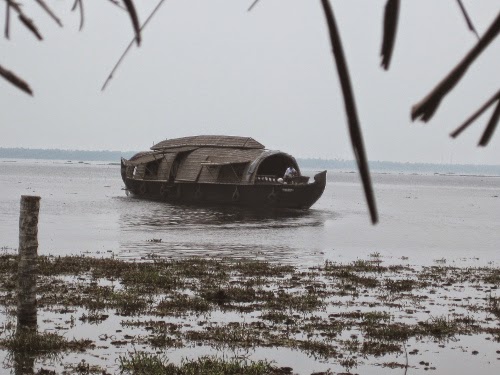
Houseboats parked at Alleppey
Houseboat on Lake Vembanad
The houseboats which potter around the lakes and canals of the backwaters represent so much of what is good and bad about the tourist push in Kerala.
The kettuvallums, the traditional boats of all sizes, are living history. No-one knows how long they have been constructed using very ancient techniques, out of Anjuli wood and coir, both abundant around the area.
In the Malayalam language "kettu" means tying and “vallam” means country boat – the two together make the local name "kettuvallam”. Those tourists lucky enough to have a trip on a genuine kettuvallum will be treated to a close-up view of the complicated tying and weaving of the coir ropes which hold the whole thing together, and the intricately woven palm-thatched superstructure. The standard kettuvallam is about 20 metres long and 4 metres wide. They are still built using traditional construction methods and mainly from local materials, bamboo poles, coconut fibre and "Anjili" (Artocarpus hirsuta) wood. The hull is a series of wooden planks, long cut and carved and tied together using coir, with coconut fibres stuffed in between. There are no nails used in the hull, and it is easy to see how the planks are tied. This framework is then coated with a caustic black resin extracted from boiled cashew kernels. Modern boats have diesel engines and a rudder and are steered using a wheel at the front. Some maintain the use of bamboo poles to punt along.

A meal on the boat
The distinctive kettuvallams have been used to transport rice and spices through the canals and waterways of Kerala for many years. They could be as much as 100 feet long and carry up to 30 tons. Today the boats are only used to carry visitors around the backwaters, their stately pace being the ideal counterpoint to the bustle onshore. From being an outmoded and dying form of transport, the kettuvallam has taken on a new lease of life and the boatyards are busy building and maintaining today’s fleet. The superstructure is made from woven bamboo, and needs to be renewed every three or four years.Inside, the boats now have every modern convenience including air-conditioning, en-suite bathrooms and well-equipped kitchens.

New boats use modern construction techniques and are metal-hulled and riveted together. They are usually lumbering monsters, lacking the grace of the traditional boats. Some have eight cabins and a jacuzzi on the roof. I just don't get it!


The driver
The source of a lot of tourist dollars, the fleet of boats working out of Alleppey has grown and grown, and with little regulation the boats are adding to the already serious pollution of the lakes and waterways. Most of the beauty of the backwaters lies along its narrow canals, which thread their way through the rice fields, lined with small houses and providing the arteries through which the commerce of the area flows. The large boats with all mod. cons cannot tackle these waterways, so lumber their way round the lake, a constant procession of primitive arks. There is much to see on the lake, but those in the know insist on a small boat and a more difficult voyage into the depths of the backwaters.

Thursday, 23 October 2014

History through objects

I have been enjoying Neil MacGregor's programmes about the history of Germany through a series of objects selected for a new exhibition. (http://www.bbc.co.uk/programmes/b04dwckb)

It got me thinking about what I would choose as representative of the periods and cultures of Kerala. How do you avoid the magpie-like selection of shiny objects? Many of the lists which already exist choose items of cultural importance, like the Aranmula mirrors which are made of bell metal, and which take days of polishing, or items collected from traditional dance forms like Kathakali. Certainly, some of these things would be important and representative, but they did not necessarily mark important changes in, or description of, the way in which the people lived, which is really what history is about.

How many should there be? I could probably manage more than 10, but fifty might be beyond me. So, I have set myself the task and designate the Bellarmine jar in my last post as item number one, even though it is chronologically adrift.


Monday, 6 October 2014

Reader feedback

I wait for reader feedback with trepidation. Although most has been very nice and positive I had a surprise last week when a friend called me to take issue with something I had said. I had expected historical disagreement, the pointing out of terrible errors and abuse, but not the point he made. On page 90 I had said, after looking for the lost railway which transported tea from Munnar:

"Processed tea went up to Top Station on a monorail system, built in 1902 and replaced by a 24 inch gauge railway in 1908. We might have arrived on the west coast, but by the time that the crop had developed into a significant export, most of it went via Madras, on the east.
The tea went up to Mattapetty and on to Top Station before taking the rope-way back to Kottakudi and to Bottom Station, in Tamil Nadu. From there it was transported to various places in India for shipment and processing. It is almost impossible to trace the railway now as it followed the course of the road, but there are remnants of the ropeway system, most recorded by Jimmy Jose on  the informative website at
http://www.irfca.org/gallery/Heritage/Kundala .

Even I nearly turned into a railway buff trying to pick out the last vestiges of this long-lost line in a changed landscape, the difficulties and rough terrain lending the endeavour a glamour I didn’t feel when contemplating the Settle to Carlisle line, for instance."

I would like to record my heartfelt apologies to one of the most interesting, spectacular and historic railways in the UK.

There is still a sneaking feeling that the vertiginous cliffs and viaducts of the railways in the Western Ghats are more romantic and engaging than the lonely line across the moors, but as I now have to admit that I have never been on the Settle to Carlisle Railway, perhaps I am in error.

This web page shows pictures of the lost Kundala Valley Railway.
http://www.irfca.org/gallery/Heritage/Kundala/

The Nilgiri Hill Railway to Ooty shows what the line might have been like today.


Thursday, 28 August 2014

Kochi-Muziris Biennale

Digging around the internet for Muziris-related information I was suddenly struck by the lack of anything about the Fort Koch-Muziris Biennale. The last one, in 2012, was a great success, but this year the event, due to start in December, is not out there yet. The biennale web site has artist interviews and reports of the 2012 event, but there is no programme. The link on the website is an impressive, completely blank page, no headers or information..

I shall probably be in Kochi in February and may catch the last of the exhibitions. It is probably the usual last-minute dash of Indian planning, but I feel uneasy on behalf of the international audience and exhibitors who should know by now what they are exhibiting and where. It is no small thing to mount an art exhibition at home, let alone a flight away. After the last success it would be sad to see this going the way of all tourist initiatives in Kerala, lots of hot air, a great launch and fanfare and then a slow sink into obscurity.

Phase Two of the Spice Trail, taking in the Muziris Heritage Project was launched in February with the creation of a new government company to oversee its development. That gives me a sinking feeling in my stomach too. Again, the web is mostly silent on current developments, apart from the usual "there will be" statements about new boat jetties etc. The original sites are being promoted, but the interesting developments are those by private individuals taking advantage of the heritage concept and creating their own spice trails within the state. There is so much to see that this may well serve the interests of "heritage" and tourism in the state far more effectively than the grandiose, stalled state projects.